Do You Need a German Erbschein? A Guide for U.S. Heirs
Do You Need a German Erbschein? A Guide for U.S. Heirs
Why Your U.S. Probate Order Is Not Enough
If you are a U.S. heir with a German bank account, a German apartment, or any other asset in Germany — you may assume your U.S. probate documents will open doors there.
They will not.
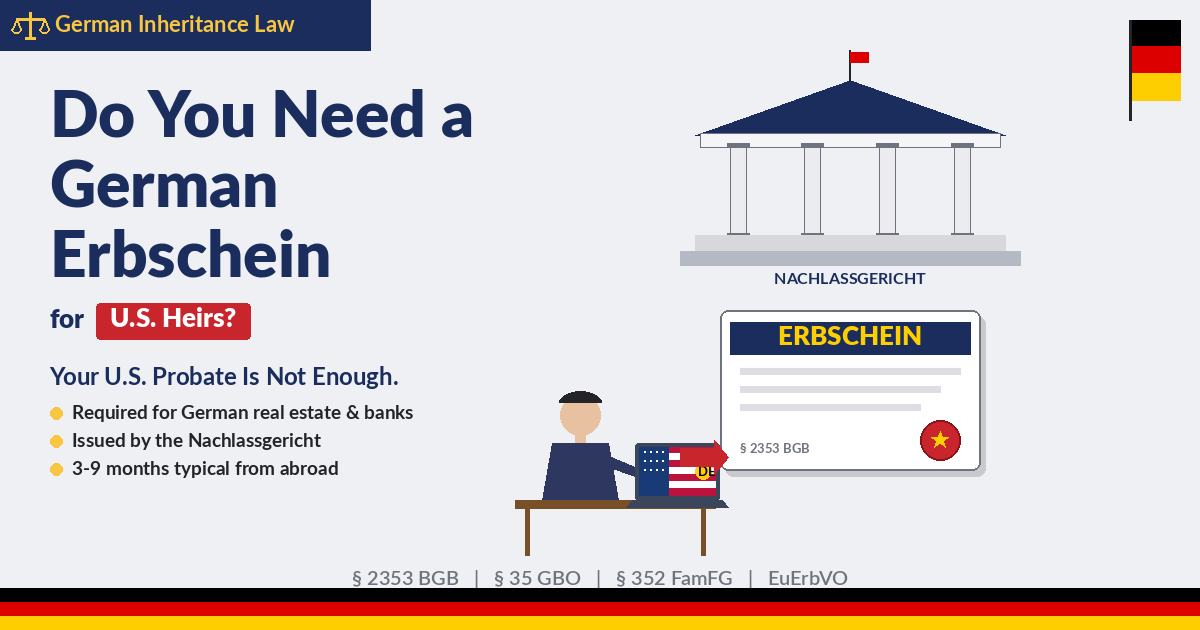
German banks, land registries, and courts do not recognize Letters Testamentary. They do not accept a U.S. probate order on its own. And they will not transfer a single euro until you produce a document they understand.
That document is usually the Erbschein — the German certificate of inheritance.
Before you try to unlock assets in Germany, you need to understand when you actually need one, how you get it from abroad, and how it fits alongside any U.S. probate you are running in parallel.
1️⃣ What an Erbschein Actually Is
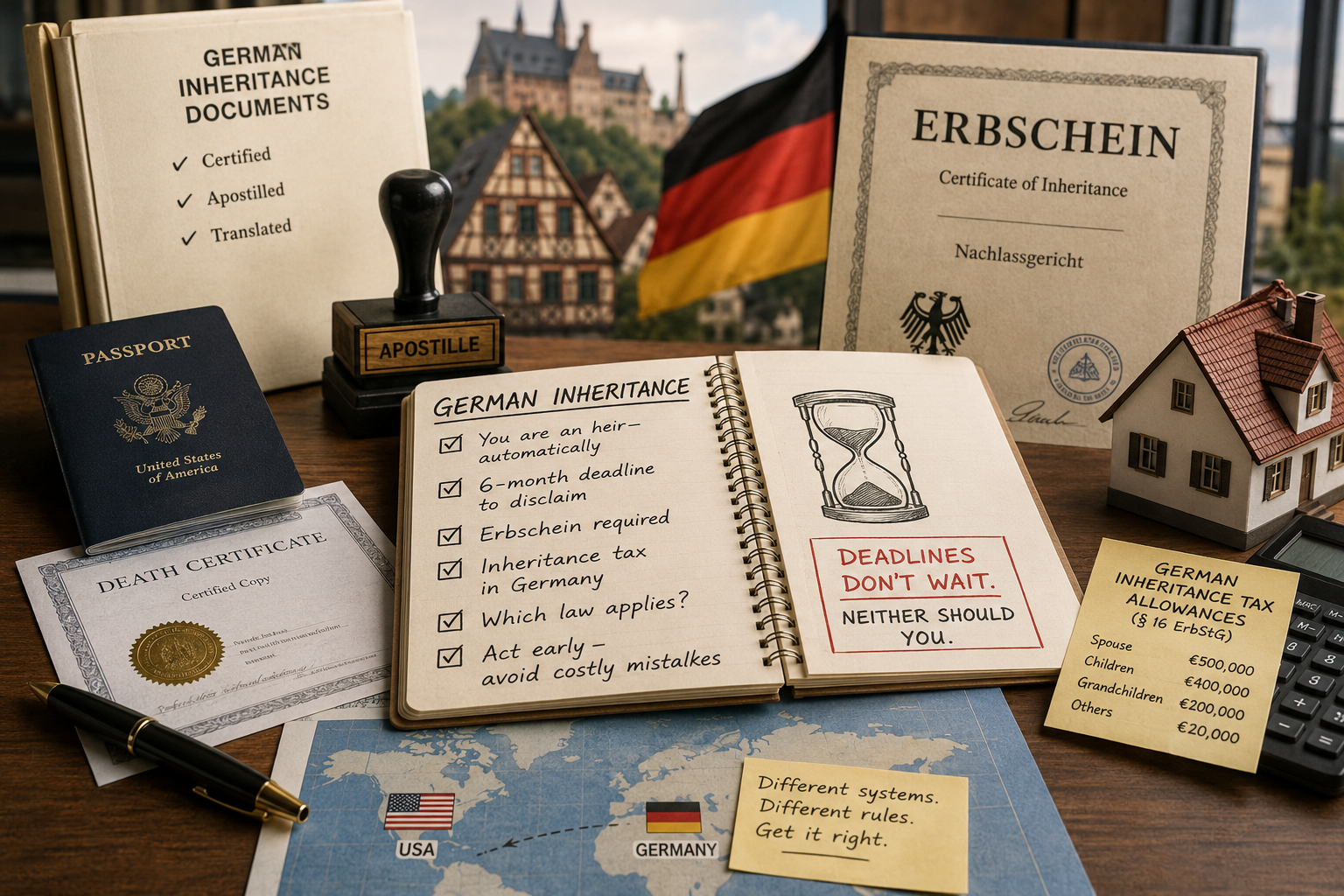
The Erbschein is a formal certificate issued by the German probate court (Nachlassgericht) under §§ 2353 ff. BGB. It names the heirs, states their shares, and identifies any restrictions such as prior inheritance or executorship.
It is not the same as a U.S. grant of probate.
- A U.S. grant appoints a personal representative to administer the estate
- A German Erbschein identifies the heirs directly — under German law, heirs succeed universally and immediately at the moment of death (Gesamtrechtsnachfolge, § 1922 BGB)
- German banks, the Grundbuchamt (land registry), and German debtors rely on the Erbschein as proof of who is entitled to act
Two conceptual systems sit behind these two documents. U.S. probate is administrator-driven. German succession is heir-driven. A paper that proves one does not automatically prove the other.
2️⃣ When a U.S. Heir Actually Needs an Erbschein
Not every German asset requires an Erbschein. Whether you need one depends on the type of asset and what documents exist.
You will almost always need one if:
- German real estate must be re-titled in the Grundbuch — § 35 GBO generally requires an Erbschein unless a notarial will or Erbvertrag is available
- German banks are asked to release balances above their internal thresholds (often around €5,000–€10,000, but this varies)
- German debtors, insurers, or registered share registries require formal proof before paying out
- There is intestate succession and no will at all
You may be able to avoid it if:
- The decedent left a notarielles Testament or Erbvertrag with an Eröffnungsprotokoll from the Nachlassgericht — German banks and the Grundbuchamt often accept this combination in lieu of an Erbschein (BGH, V ZB 40/10; § 35 Abs. 1 S. 2 GBO)
- The asset is a small bank balance the institution is willing to release against a certified copy of the U.S. probate order and a sworn statement of heirship
A purely private, handwritten will (eigenhändiges Testament) — even if validly executed — will almost never substitute for an Erbschein at a German land registry.
3️⃣ Jurisdiction and Governing Law: The Cross-Border Question
Which court issues the Erbschein, and which law it applies, is not automatic in a Germany–U.S. matter.
Under the EU Succession Regulation (EuErbVO, Regulation (EU) No 650/2012):
- Jurisdiction generally lies with the Nachlassgericht of the decedent’s last habitual residence (Art. 4 EuErbVO)
- Where the decedent lived in the U.S., German courts can still take jurisdiction over German-situs assets under Art. 10 EuErbVO
- The applicable law is typically the law of the habitual residence (Art. 21 EuErbVO) — unless the decedent made a valid choice of law for the law of their nationality (Art. 22 EuErbVO)
For a U.S. decedent with German real estate and no choice of law, this often means:
- U.S. state succession law governs the substance
- The Nachlassgericht can still issue a gegenständlich beschränkter Erbschein limited to the German assets (§ 352c FamFG)
- The German court will examine the foreign law to determine who the heirs are — a process that benefits significantly from a legal opinion from a U.S. attorney
This is one of the most misunderstood parts of a cross-border estate. „U.S. law applies“ does not mean „no German court is involved.“ It means the German court applies U.S. law to decide who inherits.
4️⃣ Applying from the United States: The Procedural Reality
The Erbschein is applied for under § 352 FamFG. For U.S. heirs, the practical hurdles are not legal — they are evidentiary and logistical.
What the Nachlassgericht will want:
- The death certificate — typically with apostille under the Hague Convention of 5 October 1961, and a certified German translation
- The will or Erbvertrag, if any — again, apostilled and translated where not already in German
- Proof of family relationships — U.S. birth and marriage certificates, apostilled and translated
- A completed Erbscheinsantrag
- An eidesstattliche Versicherung — a sworn statement that the facts asserted in the application are true
The sworn statement is where many U.S. clients get stuck.
Under § 2356 Abs. 2 BGB, the eidesstattliche Versicherung must be given before a notary or competent court. For a U.S.-based heir, the realistic options are:
- A German consul or consular officer at the German embassy or consulate
- A German notary during a trip to Germany
- In limited circumstances, German Honorary Consul or U.S. notary is permitted by the court.
Planning the sworn statement early — and confirming acceptability with the specific Nachlassgericht — saves weeks and, in some cases, a second application.
5️⃣ Timing, Cost, and Coordination With U.S. Probate
A realistic timeline for a cross-border Erbschein is three to nine months from application to issuance, depending on the court, the completeness of the foreign documents, and whether a legal opinion on U.S. succession law is required.
Cost points to budget for:
- Court and notary fees scale with the net value of the estate under the GNotKG
- Translations of U.S. documents — typically by a certified German translator
- Apostilles from the relevant U.S. Secretary of State
- Legal opinion on U.S. state law, if the Nachlassgericht requires one
Coordination with U.S. probate matters:
- U.S. probate addresses U.S.-situs assets; the Erbschein addresses the German side
- Both processes can run in parallel — they usually should
- Representations to the Nachlassgericht must be consistent with filings in the U.S. probate court: conflicting statements about heirs or shares create real problems on both sides
- The U.S. personal representative and the German heirs are not always the same people — the documents must reflect that accurately
A clean cross-border estate is not one where you pick a jurisdiction and hope for the best. It is one where each side’s paperwork lines up with the other.
What You Should Do Now
If you are a U.S. heir dealing with German assets — or a U.S. executor whose decedent left property in Germany — the early steps that matter are:
- Identify every German-situs asset and the institution that controls it
- Locate the original will, Erbvertrag, or confirm intestate succession
- Determine the decedent’s last habitual residence and whether a choice of law was made
- Collect U.S. civil status documents and plan for apostille and translation
- Decide early where the sworn statement (eidesstattliche Versicherung) will be given
- Coordinate with the U.S. executor so the two proceedings do not contradict each other
An Erbschein application is rarely urgent in the first week. It becomes urgent once a German bank freezes access or a real estate sale is blocked.
We Can Help
Our office represents U.S. heirs and executors before the Nachlassgericht, prepares Erbschein applications, coordinates sworn statements at German consulates in the United States, and works alongside U.S. probate counsel to keep both proceedings aligned.
If you have questions about a German inheritance or need an Erbschein for assets in Germany, we are ready to help.