For many American families, the revocable living trust is the backbone of the estate plan. It avoids probate, keeps matters private, and lets a successor trustee take over smoothly. In the United States, it works exactly as intended.
But if a child, grandchild or spouse lives in Germany, the trust also has to pass a second test: German tax law. And German law has a problem with trusts – it does not know them.
Germany has no trusts
German civil law has no concept of splitting ownership between a trustee (legal title) and a beneficiary (beneficial interest). When a German tax office – the Finanzamt – looks at a U.S. trust, it therefore has to translate it into categories German law does recognize. The outcome of that translation decides how much tax your family pays.
German inheritance tax follows the heir
The U.S. taxes the estate. Germany taxes each person who receives something. German inheritance tax (Erbschaftsteuer) applies to worldwide assets whenever either the deceased or the recipient lives in Germany.
That is why a U.S. estate that owes no U.S. estate tax at all can still create a German tax bill for a child living in Munich or Berlin. Close family receives generous allowances – a child can receive EUR 400,000 from each parent tax-free – but anything above that is taxed at rates between 7 and 30 percent in the most favorable tax class.
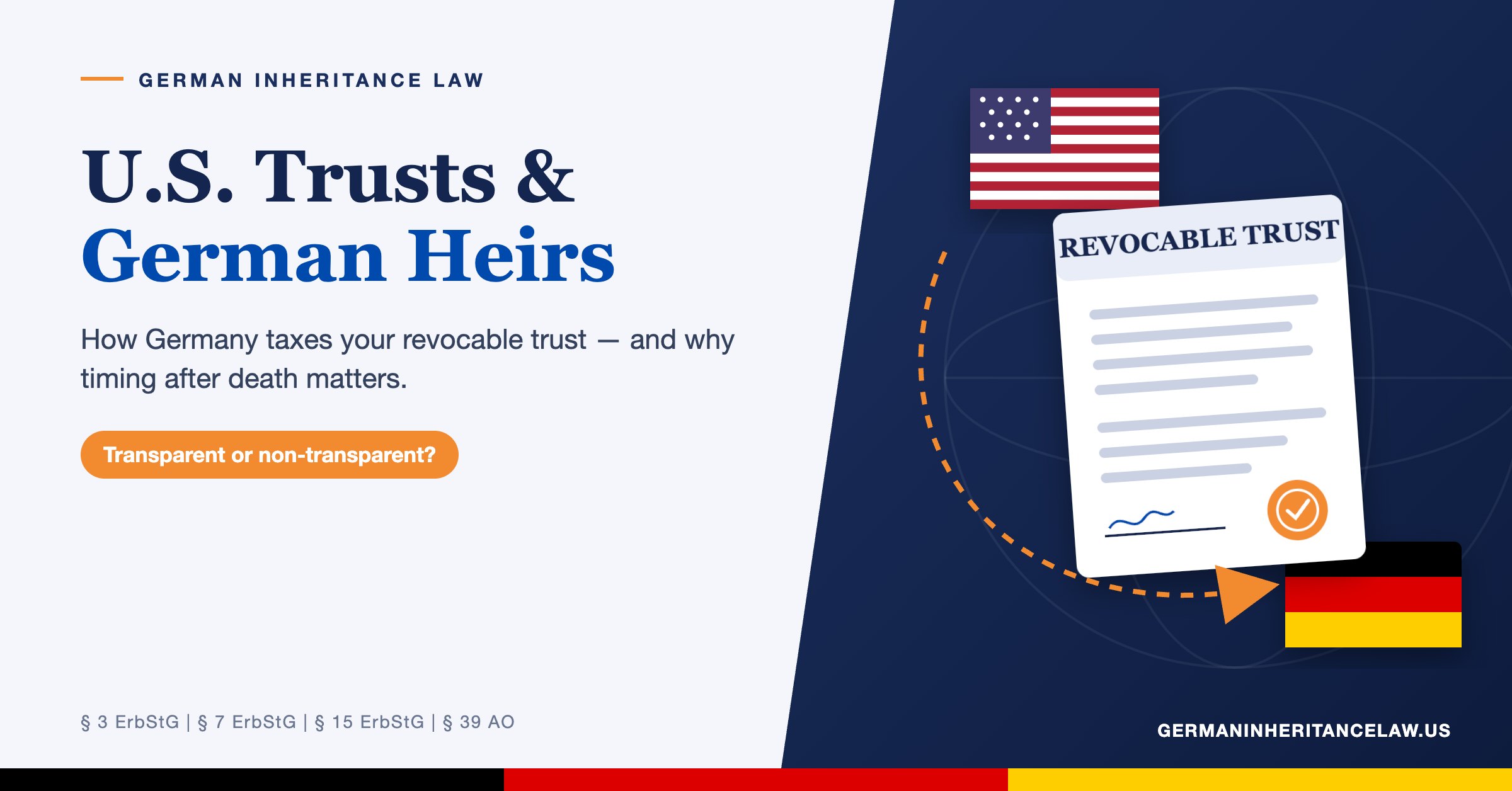
Transparent or non-transparent: the key question
For German tax purposes, every trust falls into one of two groups:
- Transparent trusts. The settlor keeps control – the right to revoke, to amend, or to instruct the trustee. Germany disregards the trust and treats the assets as the settlor’s own. A revocable living trust is transparent while the settlor is alive.
- Non-transparent (opaque) trusts. The assets have been placed irrevocably beyond the reach of the settlor and the beneficiaries, typically in a discretionary trust run by an independent trustee. Germany then treats the trust much like a foundation: a separate pool of assets (Vermögensmasse ausländischen Rechts) with its own tax consequences.
What changes when the settlor dies
During the settlor’s lifetime, a revocable trust is a non-event in Germany. At death, the right to revoke ends and the trust becomes irrevocable. From that moment, what the trust does matters:
- If the trust distributes promptly and outright, the assets simply pass through it. In our assessment, the German heir is then treated as inheriting directly from the deceased parent – one taxable event, taxed according to the family relationship, with the full allowance.
- If the trust keeps holding assets – because shares are paid out in installments, because a continuing trust holds a child’s share until a certain age, or because the trustee takes years to sell the family home – the German tax office may treat the trust as a separate pool of assets. Distributions to a German beneficiary can then be assessed one by one as separate acquisitions from the trust, whenever the beneficiary has an entitlement to them. Allowances are used up by the first payment and not renewed for ten years, the applicable tax class is disputed, and income distributions can also be subject to German income tax. The burden of showing that no entitlement existed lies with the beneficiary.
The difference between these two routes can easily amount to tens or hundreds of thousands of euros.
Is a long-term trust always a bad idea?
Not necessarily. Some advisors deliberately use a non-transparent, fully discretionary trust to keep assets outside German inheritance tax altogether. This can work in larger estates, but only under narrow conditions: among other things, the settlor and the trustee must be outside Germany, the trustee must have genuine discretion, and there should be several beneficiaries. The law in this area is unsettled, and German tax courts have recently ruled against taxpayers – most recently in 2026, where the court found that a “discretionary” trust for a single beneficiary gave her an entitlement after all. For most families, the simpler route is the safer one.
What to check before it is too late
- Distribution provisions. Does the trust distribute outright, or does it hold back shares, stagger payments or create continuing trusts for the German beneficiary?
- Timing. Is there a clear deadline for winding up the trust after death?
- Real estate. Can the house be deeded to the beneficiary in kind instead of being sold by the trustee over many months?
- The trustee. A trustee living in Germany can shift the trust’s place of management to Germany – with German corporate tax and filing obligations as the result.
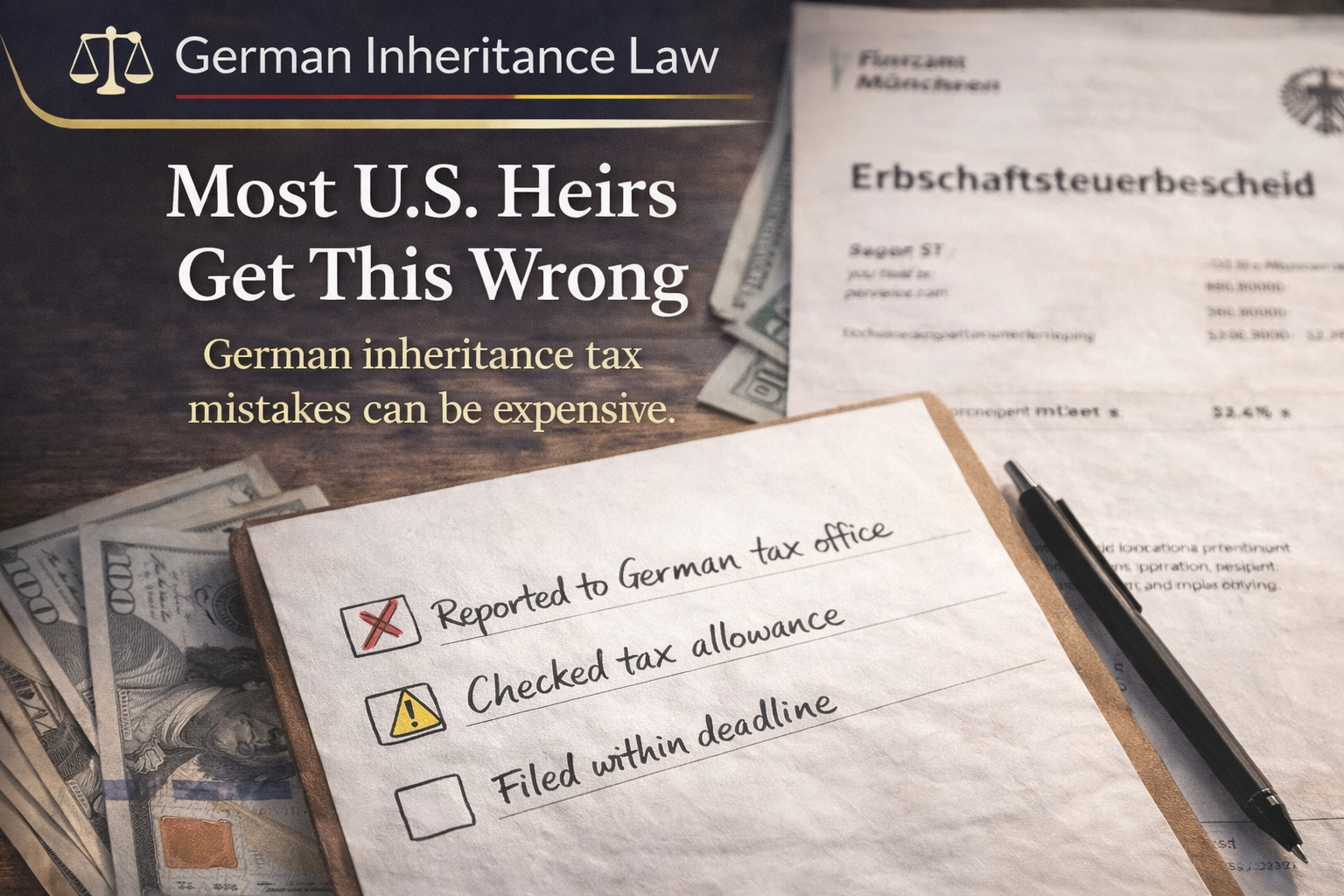
- Reporting. German heirs must notify the Finanzamt of an inheritance within three months of learning of it.
Most of these points can be addressed with a few targeted amendments – but only while the settlor is alive and the trust is still revocable.
The bottom line
A U.S. trust is designed with U.S. law in mind. If someone you love lives in Germany, it deserves a second look from the German side. We work alongside your U.S. estate planning attorney to review the trust and propose precise amendment language that works in both systems.
If your family’s plan includes a beneficiary in Germany, book a consultation.
This article provides general information only and is not legal or tax advice. It does not create an attorney–client relationship. The German tax treatment of trusts depends on the exact wording of the trust instrument and the individual facts. For your specific situation, please consult a qualified advisor.